Range Repair
Wolf Range Warranty: What It Covers and Which Parts to Buy
A Wolf range typically carries a two-year full warranty on parts and labor, then a five-year limited warranty on key parts such as burners, heating elements and control boards. Check the paper that came with your range for the exact terms before you book or order a part.
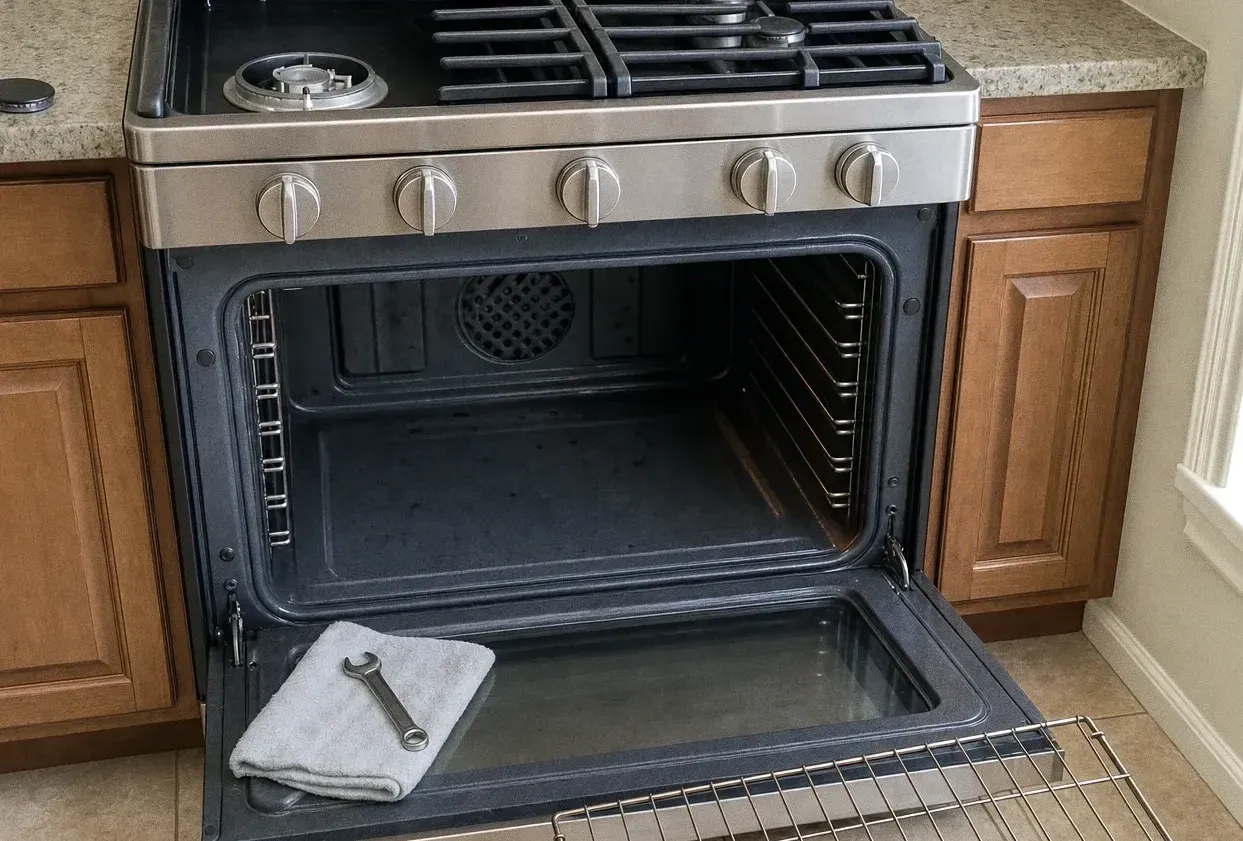
Wolf has for years backed its ranges with a two-year full warranty, which covers parts and labor on the whole appliance, followed by a five-year limited warranty on a short list of key parts such as gas burners, electric heating elements and electronic control boards. The clock usually starts on the day the range was first installed, not the day you noticed a fault, and the later years generally pay for the part but not the labor to fit it. Your own warranty sheet is the final word, because terms can change between production years, so dig it out before you call anyone or order anything.
That matters most when the range came with the house. A buyer in Milton who inherits a pro range along with the cabinets may never have seen the original paperwork, so the first useful step is working out how old the range is and whether any coverage is left at all.
What the warranty covers in each period
In the first two years, nearly any failure caused by a defect in materials or workmanship is the manufacturer’s problem: a spark module that stops clicking, an oven that will not hold its set temperature, an inner door glass that cracked without being struck. During that window, call the manufacturer’s service line with the model and serial numbers and let it send its own technician. We work independently of the manufacturer, so any repair we carried out in that period could not be billed to Wolf, and paying an outside shop for a covered repair is money you never needed to spend.
From year three through year five, the limited part of the warranty covers named components only. The list differs by product, but for a range it typically means the burners, the heating elements and the electronic controls. Igniters, knobs, door gaskets, hinges, lamps and cosmetic surfaces normally sit outside it, and the labor is usually yours to pay. After year five, every repair is out of pocket.
What a claim usually depends on
A young range is not covered automatically. Before a manufacturer pays for a repair, it usually wants a few things to line up:
- Proof of the install date. A purchase receipt, the closing papers on a new build or the installer’s invoice all do the job.
- Ordinary household use. Family cooking in a home kitchen, rather than a catering business run out of the house.
- A correct installation. The right gas type and conversion for natural gas or propane, a proper electrical supply for dual-fuel models and the clearances set out in the installation guide. Faults traced back to the hookup tend to land on the installer, not the maker.
- No outside damage. Power surges, harsh oven cleaners on the porcelain, water from a leak overhead or a heavy pot dropped on the glass are generally excluded.
- No unapproved repairs. A part fitted by someone outside the manufacturer’s network, or a non-genuine part, can give the maker grounds to turn down the related claim.
Registering the range while it is new puts the install date on record, which can spare you a hunt for receipts years later.
Genuine parts or aftermarket?
Genuine Wolf parts are built to the drawings for your exact range, so the connectors, mounting holes and wire lengths match what is already there. Aftermarket parts are copies made to fit a long list of models, and their quality runs anywhere from close to careless.
Some pieces are fine to shop around for: burner grates, control knobs, the small porcelain caps that sit over each burner, and oven racks. A loose fit there is an irritation, not a hazard. Others should be genuine every time. Gas valves, burner orifices, spark modules and igniters decide where gas goes and when it lights, and a copy that sparks weakly can let gas gather before it catches, the same lag described in our guide to delayed lighting on a Wolf burner. Oven sensors and control boards belong in that group too: a sensor that reads a few degrees off spoils a batch of bread, and a board with mismatched software can refuse to talk to the rest of the range.
Factory-approved parts cost more at the counter, but they take one unknown out of a fault that already has plenty.
Finding the right part number
Wolf revises components within a single model name over its production run, so the model alone is not enough to order a board or a valve. You need the serial number as well, and ideally the number printed on the old part itself.
Start with the rating plate. Its position varies by range style, and the use and care guide shows it, but the usual places are the frame around the oven door, the underside of the control panel edge and behind the removable kick panel near the floor. Take a sharp photograph of the whole plate so nobody has to read numbers over the phone from memory.
Next, look at the failed part if you can reach it safely. Many Wolf components carry their own label with a part number, and that number beats any online lookup. Before you take off a panel, switch off the breaker, and on a gas range close the shutoff valve behind or beside the appliance.
When you shop for Wolf range parts online, match the full part number rather than a photo or a product description. Check whether the seller lists the item as genuine or as a replacement for it, and read the return terms: many sellers will not accept an electrical part back once its packaging is opened, which turns a wrong guess on a control board into an expensive lesson.
When the coverage has run out
Out of warranty, the choice becomes a plain repair estimate. Our visit is a flat $95 for the trip and a full diagnosis, and that sum is credited to the repair if you decide to go ahead. Typical ranges for common range work across Milton, Canton, Wollaston and Hyde Park:
- Igniter or spark module replacement: $280–$690
- Burner valve or orifice service: $240–$1,060
- Oven thermostat or sensor calibration: $140–$710
- Control board or touch panel: $550–$1,670
The firm price comes after diagnosis, once the correct part number is confirmed. Even the top of those ranges is a small share of what a comparable new pro range costs before installation, so a sound range with one failed part is usually worth fixing. Our range repair page explains what a visit covers, or call (617) 396-3696 with the model and serial numbers to hand.
Asked on the same call
Does the Wolf warranty carry over if I buy a house with the range already installed?
It depends on the wording of the warranty, so read it rather than assume either way. Coverage is usually counted from the original installation date, not the day you moved in, so a range in a house that changed hands may be partway through its terms or past them. Ask the seller for the purchase or install paperwork, then call the manufacturer with the serial number to confirm what is left.
Will an aftermarket part void my Wolf range warranty?
It can, for the failure that part is linked to. Warranties generally exclude damage caused by non-genuine parts or by repairs the manufacturer did not arrange, so while the range is still covered, let the manufacturer's own service line handle the work. Once coverage has ended, the question becomes fit and safety rather than paperwork.
Which label on a Wolf range shows its model and serial number?
They are printed together on a rating plate whose position varies by range style. Common spots are the frame around the oven door, the underside of the control panel edge and behind the removable kick panel at floor level, and the use and care guide shows the exact place. Photograph the whole plate before you call or order.
Are Wolf range parts sold online the same as the ones a technician fits?
Sometimes, but not always. Online listings mix genuine parts with look-alike replacements, often on the same page. Buy only when the listing shows the genuine part number that matches your serial number or the label on the old part, and read the return terms first, because many sellers refuse an opened electrical part.
What does it cost to have a Wolf range diagnosed after the warranty ends?
Expect a flat $95 for the visit, which includes a full diagnosis and is deducted from the bill when you go ahead with the repair. Typical ranges then follow the part: an igniter or spark module job usually falls at $280–$690 and a control board or touch panel at $550–$1,670, with the firm quote given once the fault is found.